Alistair Grant painted not so much the attenuated sheaths of things, but signs for them — signs and signals from the interior, indicative of a richer experience and knowledge of life than is generally allowed by the naturalism of external appearances.
They have something in common with the ideograms of Miró, those symbolic forms. But Grant's paintings are not simply knowing images; they are traces of real emotion, as well as a response to a particular place.
A late Grant painting is a dance of shapes, each of which demands its own certain position — the artist is engaged in a proper choreography of the plage. The discrete elements operate on different levels: pure form meeting and mingling, colour luring, a context into which all of these pieces can be filled. This requires the kind of fine organising intelligence that was one of Grant's greatest gifts.
Although Grant always remained a landscape painter, he was also — like Cézanne or Joyce — a chronicler of the "inscape". His paintings convey the fruits of his inner life, his private experience. The viewer feels that Grant loves what he is painting — the initial motif — and that he has only deepened the game by abstracting it. His aim is not to hide the subject, but to explore it in a new way. It is by no means a retreat from the world, but a celebration of it.
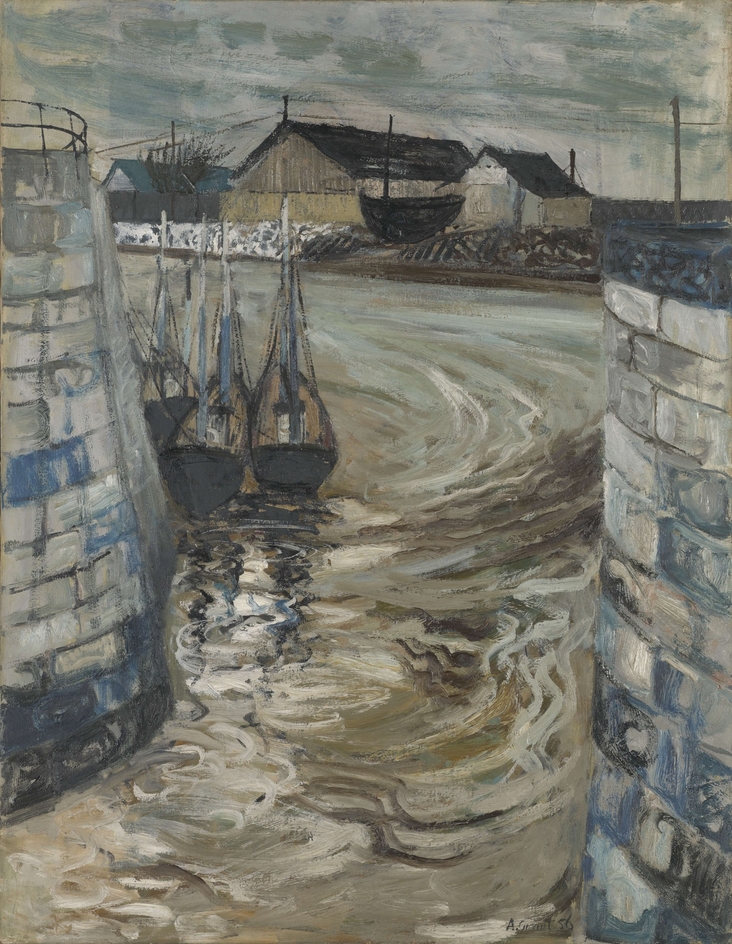
Boats at Honfleur, c.1980s
Browse by period